
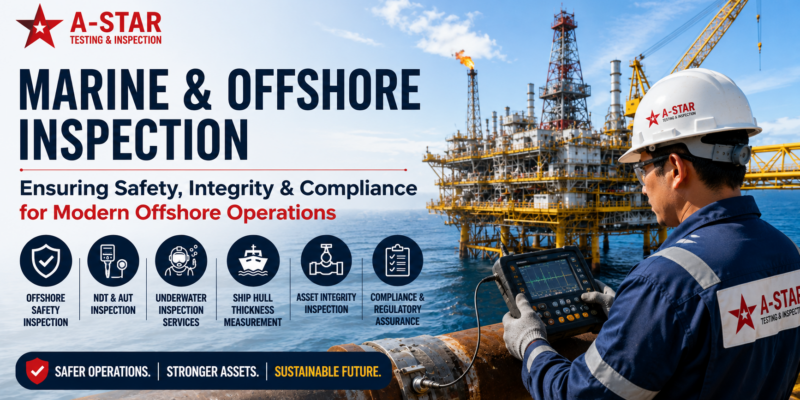
The offshore industry is one of the most challenging and perilous industries in the world. Corrosion, pressure, fatigue, and harsh weather conditions are constantly faced by offshore platforms, FPSOs, drilling rigs, marine vessels, and subsea infrastructure. Under these conditions, the safety and reliability of operations and structures are essential. This is where Marine & Offshore Inspection comes into play for today’s offshore operations.
In today’s context, Singapore and other maritime hubs offshore companies are using cutting-edge inspection technologies to mitigate operational risks, boost asset performance, and meet global maritime safety standards. Whether it is underwater inspections, non-destructive testing, or offshore asset integrity management, inspection services are a significant part of the playing field for successful and safe offshore operations.
Understanding Marine & Offshore Inspection
Marine inspection is the process of assessing ships, offshore structures, marine equipment, and subsea assets for defects, corrosion, structural weakness, and operational hazards. Offshore inspection services help to ensure critical infrastructure is safe, compliant, and fully functioning.
A professional Marine & offshore inspection Company in Singapore offers inspection services for:
- Offshore platforms
- FPSOs
- Marine vessels
- Drilling rigs
- Pipelines
- Ship hulls
- Cranes and lifting equipment
- ubsea structures
Periodic inspection programs can identify problems before they get to the point of being serious safety or financial concerns for offshore operators.
Why Offshore Operations Need Regular Inspection
Offshore operations are characterized by high-value assets and a very aggressive marine environment. Seawater, humidity, vibration, and heavy loads during operation are destructive forces that can be cumulative.
Key Reasons Inspection Is Essential
Improved Offshore Safety
In the offshore industry, safety is the prime factor. Inspection services are a valuable tool to uncover structural damage, corrosion, leaks, and equipment failures before they cause any accidents.
A good Offshore Safety Inspection program will reduce the risks associated with operations and safeguard personnel and infrastructure.
Regulatory Compliance
Offshore companies have to adhere to international maritime regulations, requirements of classification societies, and industry safety standards.
The operators can ensure standards are met through routine Marine Compliance Inspection services provided by:
- International Maritime Organization (IMO)
- IACS guidelines
- ABS
- DNV
- Lloyd’s Register
Failure to comply may lead to operational shutdowns, penalties, and safety risks.
Reduced Downtime and Maintenance Costs
Major production losses can be caused by unexpected equipment failures. Preventative inspection can help to find problems early and will minimise repair costs and loss of production time.
Advanced inspection technologies are a key component of many offshore operators’ shift toward predictive maintenance strategies.
Importance of Rig Inspection Services
Offshore drilling rigs are extremely complex constructions that are stressed beyond their limits. Inspections of drilling equipment and operations follow standard safety procedures to maintain safe equipment and drilling operations.
The professional Rig inspection services in Singapore consist of:
- Structural integrity checks
- Crane and lifting equipment inspection
- Weld inspection
- Corrosion assessment
- Mechanical equipment evaluation
- Safety system testing
A reliable Rig Inspection Company Singapore guarantees the safety and well-functioning of offshore rigs in challenging maritime conditions.
Role of Non-Destructive Testing in Offshore Industries
One of the most important technologies for modern offshore inspection is the Non-Destructive Testing (NDT). NDT is a method for detecting internal defects with no damage to structures or equipment.
Common NDT Methods Used Offshore
Ultrasonic Testing (UT)
Measured in thickness and for corrosion detection.
Magnetic Particle Testing (MPT)
Detects cracks in metal components on the surface.
Radiographic Testing (RT)
Identifies problems in an internal structure.
Automated Ultrasonic Testing (AUT)
AUT and NDT Inspection companies in Singapore use advanced AUT systems to inspect pipelines and welds offshore.
NDT solutions increase inspection accuracy and minimize operational disruptions.
Underwater Inspection for Marine Structures
Access to subsea structures is challenging and needs special inspection techniques. Companies providing underwater inspection services in Singapore employ divers, remotely operated vehicle (ROV) and underwater NDT technologies for detailed underwater inspection.
How can Underwater Inspection be applied?
- Ship hull examination
- Offshore platform inspection
- Subsea pipeline monitoring
- Assessment of ports and jetties.
- Marine foundation evaluation
Underwater inspections are carried out regularly, not only for the security of the structures but also to avoid environmental incidents.
Ship Hull Thickness Measurement and Corrosion Monitoring
One of the most serious problems of marine structures is corrosion. Over time, hull thickness is reduced due to the constant exposure to sea water.
With precise Ship hull thickness measurement, ship operators can:
- Detect metal loss
- Improve maintenance planning
- Ensure vessel safety
- Meet classification requirements
- Extend vessel lifespan
Because of the non-invasive and reliable measurement nature of the ultrasonic thickness testing method, it is widely used.
Asset Integrity Inspection in FPSO Operations
One of the most important offshore assets for an oil and gas operation is an FPSO (Floating Production Storage and Offloading unit). Ensuring structural reliability is crucial for uninterrupted manufacturing and ecological security.
Importance of Asset Integrity Inspection
Professional Asset integrity inspection in FPSO operations aids in monitoring:
- Structural fatigue
- Corrosion levels
- Pipeline integrity
- Pressure vessel conditions
- Mechanical reliability
Offshore Asset Integrity Management (OAM) strategies enable the offshore assets to be optimally managed during their life cycle whilst keeping the risks associated with operations to a minimum.
Technologies Transforming Offshore Inspection
The modern inspection firms are making use of technologies that are more sophisticated and efficient, in order to enhance safety and effectiveness.
Trending Offshore Inspection Technologies
- Drone-based inspection systems
- Robotic underwater inspection
- Digital inspection reporting
- AI-powered defect analysis
- Real-time corrosion monitoring
- Predictive maintenance software
These technologies enable quicker inspections with reduced human exposure to dangerous conditions.
How to Choose the Right Offshore Inspection Partner
Choosing an experienced inspection provider is crucial for the successful conduct of offshore operations.
Factors to Consider
- Certified inspection professionals
- Experience in offshore industries
- Advanced NDT capabilities
- Compliance expertise
- Strong safety practices
- Detailed reporting systems
A knowledgeable inspection company can make a big difference to the reliability and compliance of operations.
Frequently Asked Questions (FAQs)
Q1. What does Marine and Offshore inspection mean?
Ans: A thorough examination of marine vessels, offshore structures, and equipment for safety, compliance, and structural integrity.
Q2. Why is NDT important in Offshore inspection?
Ans: NDT offers a way to detect faults without causing harm to the structure, particularly valuable in the offshore environment where safety and continuous operation are critical.
Q3. Why is it important to measure the thickness of the hull of a ship?
Ans: It can be used to detect corrosion and metal loss, promoting safety and compliance with regulations in vessels.
Q4. How frequently do offshore rigs need to be checked?
Ans: The frequency of inspections is dependent on the operational environment and regulatory requirements, but one of the key requirements for offshore safety is routine inspections.
Q5. What is Offshore Asset Integrity Management (OAM)?
Ans: This involves keeping offshore assets in safe working condition through inspection, maintenance, and risk monitoring plans.
Conclusion
As the offshore industry continues to evolve and grow more complex, the importance of inspection services to ensure safety, regulatory compliance, and operational efficiency continues to rise. From underwater inspections, rig assessments to cutting-edge NDT solutions and asset integrity evaluations, modern inspection practices can assist offshore operators in reducing risk and maximizing long-term performance.
Investing in professional Marine & Offshore inspection services can help businesses meet regulations, prevent costly setbacks, and enhance the safety standards of their operations. The offshore industry today is competitive, and proactive inspection strategies are essential in achieving sustainable and reliable operations.